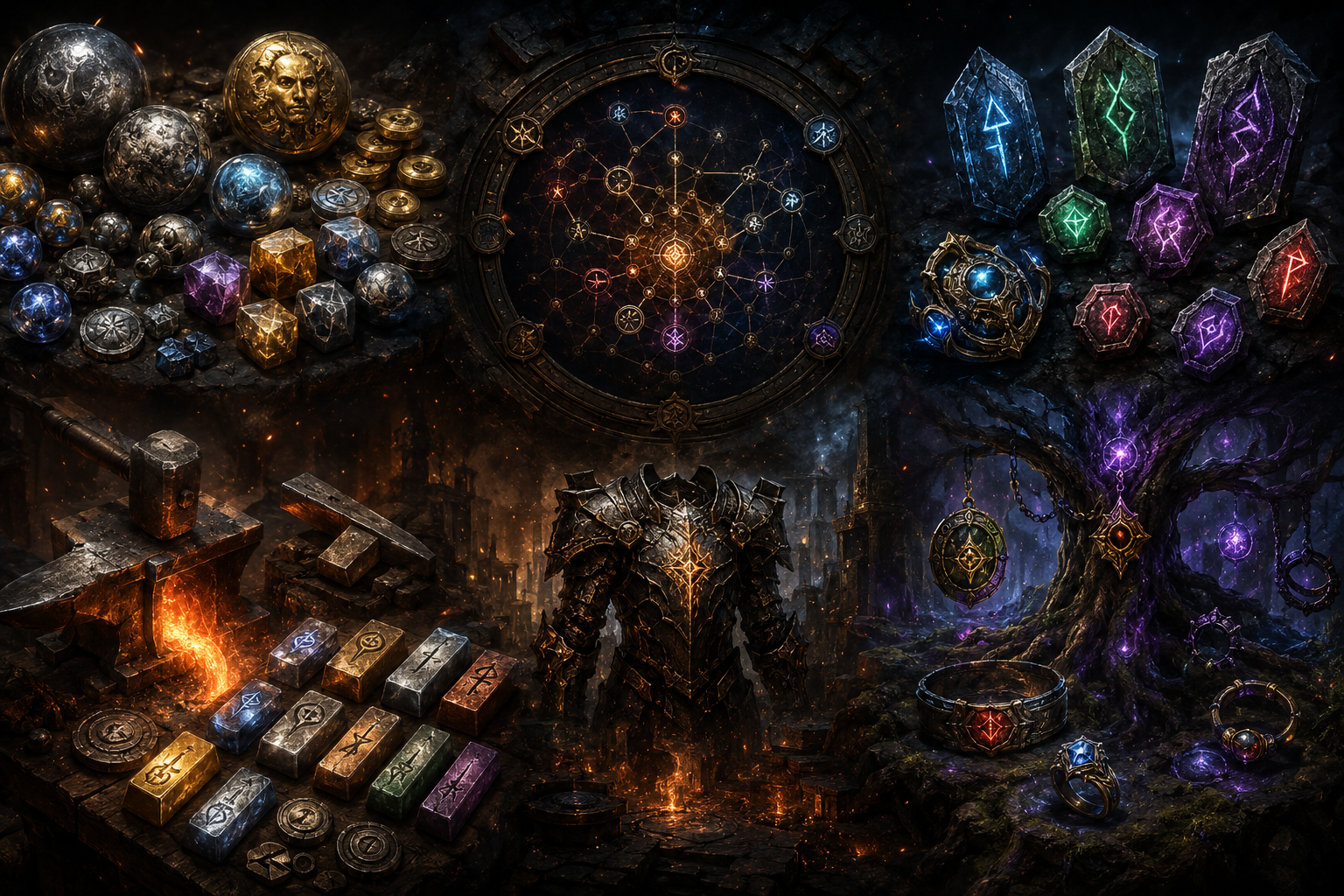
The 0.5 update for Path of Exile 2—featuring the Return of the Ancients / Runes of Aldur league—represents one of the most significant economic resets in the game so far. With a full currency rebalancing, major crafting system reworks, and an entirely new rune-based progression layer, the in-game economy has shifted dramatically in both early and endgame stages.
Core Currency Rebalancing: Inflation, Scarcity, and Shifting Value
Divine Orbs are now more common, which changes their long-standing role as a rare, high-value benchmark. While they remain essential for rerolling item values, their increased drop rate has caused a relative price drop across the economy. However, demand remains strong in the late game, especially for min-max crafting, which keeps them stable as a core trading poe 2 currency.
On the opposite end of the spectrum, Greater and Perfect-tier currencies have become significantly rarer. In particular, Transmutation and Augmentation-type currencies have been heavily adjusted, making early crafting progression more deliberate and resource-sensitive.
Interestingly, Greater Transmutation and Greater Augmentation now drop as early as Act 4, due to a lowered minimum modifier level requirement (reduced from 55 to 44). This creates a smoother early-game crafting curve while pushing scarcity into higher-tier optimization stages.
Meanwhile, Perfect Orbs have become substantially rarer, and their value has increased accordingly. These are now premium crafting tools, primarily used in high-end gear optimization and bulk trading between dedicated crafters.
Overall, the economy now follows a clearer split:
Early game: more accessible crafting tools, but limited scaling power
Endgame: sharper scarcity and higher crafting costs
Mid-tier: compressed progression due to Greater currency adjustments
New Crafting Economy: Verisium, Alloy, and Runeforging
The most transformative change in 0.5 is the introduction of entirely new crafting currencies and systems.
Verisium Metal and Runeforging
Verisium Metal is a new crafting currency dropped by Remnant-revived monsters. It fuels the Runeforging system, allowing players to imbue armor with Runic Ward properties.
This system introduces a new defensive scaling layer that competes directly with traditional armor optimization, creating new build archetypes centered around Runeforged survivability.
Alloy System: Targeted Crafting at a Cost
The introduction of 13 different Alloy currencies marks a major shift in deterministic crafting.
Unlocked after Act 2 via Remnant progression, Alloys allow players to:
Add specific crafted modifiers
Replace existing affixes
Control item direction more precisely than ever before
However, there is a major restriction:
Each item can now only have one crafted modifier.
This dramatically reduces crafting stacking potential and forces players to make more meaningful decisions per item slot. While this is a nerf to old multi-craft systems, it significantly increases the strategic value of each crafting attempt.
Alloy trading has already become one of the most active segments of the new economy due to their deterministic power.
Runes and Soul Cores: The New Trading Backbone
Perhaps the most exciting addition is the Rune system, which introduces over 100 new socketable items.
Runes are structured into tiers:
Lesser Rune
Rune
Greater Rune
These can be socketed into gear to provide persistent stat bonuses, making them a hybrid between gems and passive item modifiers.
Even more valuable are Soul Cores, which function as enhanced rune variants with stronger effects and significantly higher trade value.
Because Runes are both scalable and universally useful, they have quickly become a central pillar of the economy. Rune farming is now one of the most efficient ways to generate consistent wealth, especially in mid-to-late progression.
Genesis Tree: A New Resource Sink
Another major addition is the Genesis Tree, a crafting hub that consumes multiple materials to generate:
Rings
Amulets
Belts
Currency items
This system acts as a controlled RNG crafting engine, absorbing excess resources from the economy while providing high-variance rewards.
Its introduction helps stabilize inflation by creating continuous demand for crafting inputs, especially mid-tier currencies and Alloy materials.
Economic Impact: A More Stratified and Active Market
Overall, the 0.5 update reshapes the Path of Exile 2 economy into a more structured but more complex system:
Low-tier currencies are less abundant and more valuable in early progression
Divine Orbs are more accessible but no longer dominate value scaling
High-end crafting materials (Perfect Orbs, Soul Cores)are significantly more expensive
Rune and Alloy systems create new trade markets with constant demand
The result is a more active and diversified economy, where multiple currency types now hold meaningful value instead of a single dominant standard.
Path of Exile 2 0.5 is not just a balance patch—it is a full economic redesign. By introducing new crafting layers like Runes, Verisium Runeforging, and Alloy modification systems, Grinding Gear Games has effectively expanded both the complexity and depth of the game’s currency ecosystem.
For players, this means one thing: adaptation is essential. Those who understand the new currency flows and identify high-demand crafting materials early will have a major advantage in the evolving league economy.