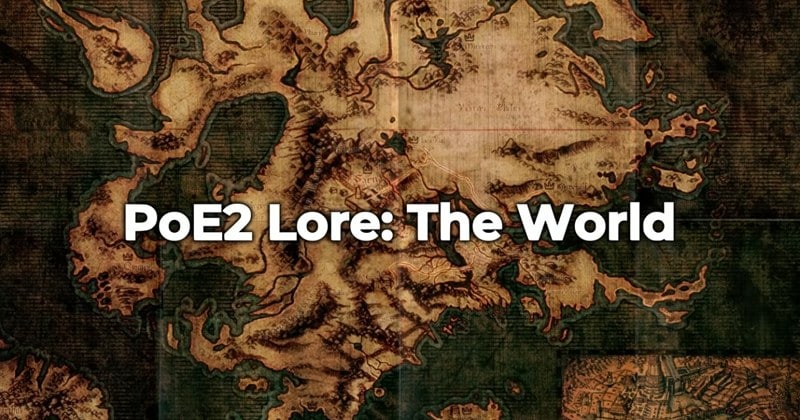
Path of Exile 2 follows a trail of corruption through forests, deserts, drowned cities, and distant islands. Each region carries evidence of an earlier struggle: clans resisting an empire, a fertile country losing its waters, or a civilization discovering powers it cannot control. The campaign connects these histories through the growing threat of the Beast.
The geography also extends outside mainland Wraeclast. Ngamakanui introduces the Karui archipelago, while Oriath brings the story back to an island scarred by the events of the original game. The announced 1.0 release, scheduled for December 11, 2026, adds Acts 5 and 6 to complete the campaign, including the return to Oriath.
Ogham: Ezomyte History Beneath the Forest
Ogham, the setting of Act 1, is an ancestral home of the Ezomytes. Its history reaches into the wider region of Phaaryl and the migrations that helped populate Ezomyr. Forest paths, settlements, and burial grounds preserve traces of a people whose identity survives through clans, songs, and stories.
The Eternal Empire left a brutal mark here. In the Cemetery of the Eternals, imperial tombs stand above older Ezomyte graves. The Red Vale recalls the bloody struggle against Eternal occupation, a victory that cost the clans generations of lives. These places explain why Ogham’s ruins carry such bitterness: the architecture records conquest as much as craftsmanship.
By the opening of Path of Exile 2, Count Geonor’s rule has become another source of suffering. Una remembers a kinder man, but the curse spreading through Ogham has changed him. His descent turns a local ruler into the central threat of Act 1, culminating in the confrontation at Ogham Manor.
The Tree of Souls and the Hooded One
The Tree of Souls concentrates Ogham’s history into a single landmark. Ezomyte ancestors used it to attract fey spirits. Under Eternal occupation, it became an instrument of terror, with living captives suspended from its branches and left to die.
The player encounters the Hooded One bound to this same tree. Freeing him requires rune spikes and Una’s assistance, tying an early campaign objective directly to the region’s older traditions. A sacred site corrupted by imperial violence becomes the place where the pursuit of the Beast gains a mysterious ally.
The Vastiri Desert: The Lost Land of Seven Waters
Act 2 moves into the Vastiri, where sand and ruined stone conceal a very different past. Ancient wayfarers’ inscriptions describe the Land of Seven Waters as a fertile destination, with productive plains and forests supplying distant empires. Keth welcomed travelers to a city defined by abundance.
That history changes the meaning of the desert. The ruins belong to communities that once expected water, food, and trade to sustain them. Even an old testament records the fading memory of snowfall and the long absence of rain. The Vastiri’s barrenness represents a prolonged loss that its surviving monuments cannot reverse.
The Halani Gates, Deshar, and the desert caravan routes connect this environmental history to the campaign’s immediate conflict. Traveling with the Ardura Caravan, the player pursues enemies using unnatural sandstorms to obstruct the chase. Reconstructing the Horn of the Vastiri requires following the legacy of the heroine Orbala.
Maraketh, Faridun, and Jamanra’s Return
The war in the Vastiri grows from divisions within its own people. The Faridun are outcasts rejected by Maraketh society, including those abandoned in infancy and adopted by desert tribes. Many still regard themselves as Maraketh and seek recognition from the communities that excluded them.
Countess Oriana exploits that desire by restoring their long-dead leader, Jamanra, through corruption. His army transports the developing Beast aboard the Dreadnought and searches for powerful remains to feed it. Deshar’s honored dead become targets, turning a sacred burial place into a resource for a new catastrophe.
Jamanra’s resurrection gives the conflict its tragedy. A movement rooted in rejection becomes entangled with a creature whose growth threatens everyone in the desert. His campaign shows how old grievances give corruption an opening.
The Vaal Heartland: Jungle, Waterways, and Buried Machines
Act 3 enters the tropical remains of Vaal civilization, moving through marshes, jungle ruins, waterways, and the drowned city associated with Utzaal. The search now turns toward someone who understands the Beast and knows how to stop it.
Vaal engineering remains dangerous long after its builders’ disappearance. Jiquani’s Sanctum contains generators, constructs, sentinels, and other machinery alongside undead inhabitants. The surviving systems suggest a civilization capable of sustaining elaborate infrastructure, even as that infrastructure becomes hostile to later visitors.
The region also contains living communities with their own conflicts. The Azak and Orok inhabit parts of the jungle and marshes, and their rivalry shapes the dangers described by local characters. Treating the entire region as an empty Vaal ruin misses the people who have claimed it since.
Utzaal and Aggorat: Seeing the Vaal Before Their Fall
Act 3 allows the player to encounter both the present and the past of Utzaal. That shift makes the Vaal’s destruction immediate: the drowned remains can be compared with a functioning city whose inhabitants do not yet know what awaits them.
Aggorat sharpens the connection between grandeur and sacrifice. Its broad paths and temple walls lead from floral decoration toward spaces filled with corpses, while cultists chant in Atziri’s name. The setting places ceremonial beauty beside the violence sustaining it. The Vaal’s struggle against death has already become a threat to the living.
Ngamakanui: The Karui Archipelago in Act 4
Ngamakanui changes the campaign’s rhythm through sea travel and island exploration. Act 4 sends the player into the Karui archipelago to recover pieces of an ancient weapon capable of confronting the Beast. Much of the opening island exploration can be completed in different orders.
The islands have distinct environments and dangers. The Isle of Kin, Whakapanu Island, Shrike Island, and Kedge Bay form separate destinations, while the Singing Caverns contain the siren Diamora, Song of Death. Sacred places and ancestral trials connect the journey to Karui spiritual traditions as well as the immediate hunt for the weapon.
Kingsmarch provides the port from which this expedition develops. Its Kalguuran residents connect Wraeclast’s coastal trade with people from a distant homeland, giving the campaign a setting where migration, craftsmanship, and maritime ambition meet.
Equipment and Currency Between Expeditions
The campaign’s dangerous routes also give equipment preparation a practical purpose. Currency items support crafting: an Orb of Transmutation upgrades a normal item to magic rarity, while an Exalted Orb adds a random modifier to a rare item. Players searching for POE2 Currency for sale benefit from understanding these functions before deciding which resources suit their equipment goals.
Oriath: The Twilight Order’s Rebuilt Stronghold
Oriath carries the consequences of the original Path of Exile. Kitava’s devastation was followed by Sirus’s assault, which left the island burned and forced its surviving population to seek safety elsewhere. Its former authority could not protect it from the powers unleashed around it.
The Twilight Order remained. After a long existence in secrecy, it rebuilt Oriath’s heart while much of the outside world believed the island abandoned. Its stated purpose is to free humanity from divine tyranny, a cause made dangerous by the methods its members accept.
The forthcoming return to Oriath brings that conflict into the campaign’s closing chapters. Announced Act 5 details describe an approach through the city to lower its harbor chains, opening a route for allied forces. The ruined island becomes a fortified center of opposition, with the Twilight Order and the Beast at the heart of the struggle.
Kalguur and Middengard: A Homeland Across the Sea
Kalguur is the homeland of the Kalguurans, located on the distant continent of Middengard. Its cold conditions and volcanic terrain distinguish it from the forests and deserts encountered on mainland Wraeclast. Dannig’s recollections connect home with snow, flowing lava, and dark peaks.
Kalguuran expertise also offers another approach to supernatural power. Dannig practices runecraft, yet the virtue gems used by Wraeclast’s inhabitants remain an enigma to him. His inability to use them raises questions about the relationship between gems, their users, and the forces behind their abilities.
The Far South and Innocence’s Exile
The far south survives largely through the testimony of Innocence. After recognizing the destruction committed through his pride and religious authority, he chooses isolation at the southern edge of the known world. He describes a place of ice, ash, fierce seas, and violent storms.
His departure leaves a different kind of unresolved history. While the Twilight Order seeks freedom from gods through confrontation, Innocence withdraws to consider how he can repair the lives he destroyed. The frozen frontier becomes the place where a god must face responsibility without the protection of worshippers or an empire.